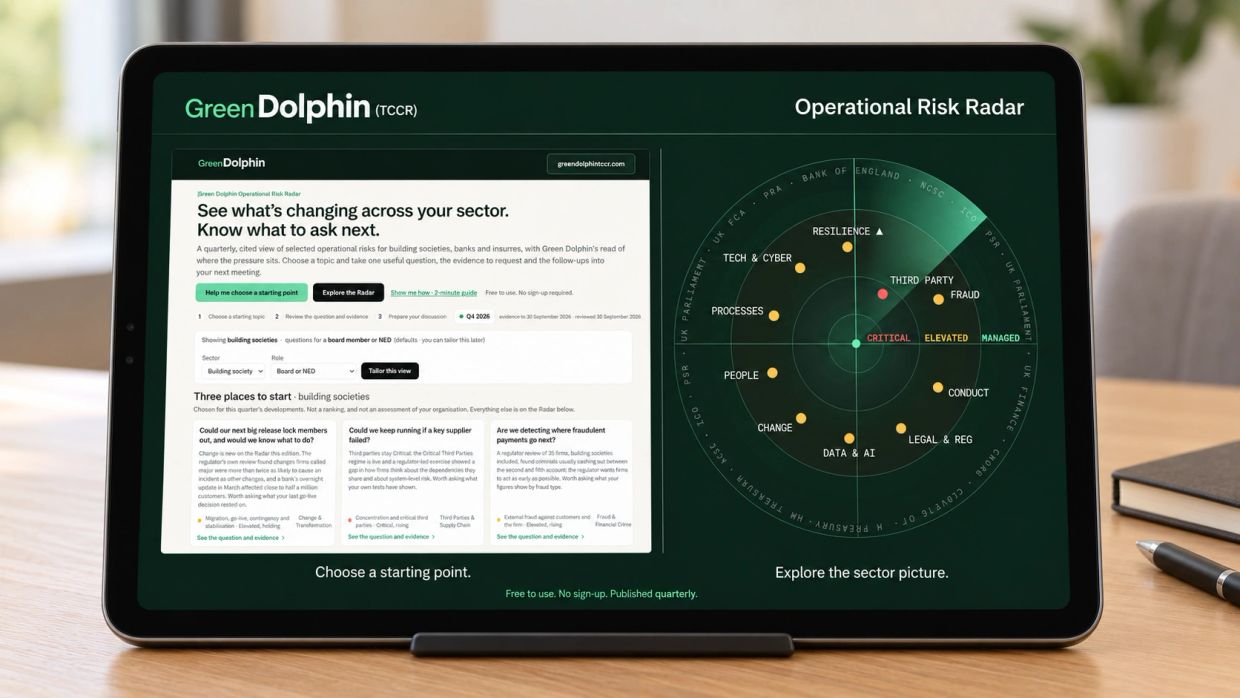
An authoritative up-to-date view of the sector's operational risk landscape for your next board meet
A clear, cited view of your sector’s operational-risk landscape for your next board or committee meeting.
The board member who can see the pattern and articulate what it means for their firm is the one asking the right questions.
You need to understand what is shifting across your sector, not just within your own firm. The regulatory developments, enforcement actions and reported incidents that could change what deserves attention at your next meeting.
But you do not have time to read every regulator publication, NCSC advisory and parliamentary report - or work through what each means for your organisation.
That is the gap the Green Dolphin Operational Risk Radar helps close.
It brings the sector picture together with questions to raise, evidence to request and Green Dolphin’s view of the implications worth discussing.
Free to use. No sign-up required. Published quarterly.
Access the Radar
Access this latest innovation and be part of our inner circle Green Dolphin community who gets priority access and information. 👇🏼
Case Study
First Line Assurance Support for a Cloud Migration
Challenge
An SME bank was preparing to migrate its on‑premise infrastructure, systems, and APIs to a combination of Cloud Service Providers and new third‑party partners.
Recognising the scale and risk of the transformation, the Chief Operating Officer (COO) asked us to provide independent first line assurance to support the Technology and Change Team and the Head of Operational Resilience.
The bank needed confidence that the change was controlled, pitfalls avoided, and residual risk understood throughout the journey - particularly given ongoing regulatory scrutiny following several problematic change initiatives.
Approach
We worked alongside Technology, Operational Resilience, and Supplier Management teams as a critical friend, providing constructive challenge, proportionate support, and evidence‑led assurance.
Our work focused on:
- Assessing cloud readiness, control maturity, and supplier governance
- Reviewing migration plans, architecture decisions, data flows, and shared responsibility models
- Evaluating new suppliers, contracts, SLAs, resilience commitments, and exit provisions
- Ensuring Important Business Services, impact tolerances, and dependency mapping informed the migration approach
- Providing clear, actionable assurance reporting to the COO and programme leadership
We also used the proprietary Green Dolphin contract database to provide a commercial review of third‑party contracts and schedules. This complemented (but did not replace) legal review, focusing on areas such as payment milestones, remedies for under‑performance, change control, exit planning, and transparency of costs.
Throughout, our role was to challenge constructively while enabling safe, confident delivery.
Outcome
The bank gained a clear, independent view of the risks, controls, and supplier responsibilities underpinning its cloud transformation, giving the COO the confidence to demonstrate to the Board and Regulator that the migration was being governed and delivered safely.
Key outcomes included:
- Clear evidence of alignment to PRA and FCA outsourcing and resilience expectations
- A credible, risk‑based migration plan grounded in real‑world dependencies
- Stronger cross‑team clarity between Technology, Operational Resilience, and Supplier Management
- Early visibility of issues that could have affected resilience, security, or customer outcomes
The COO was able to present a confident, defensible assurance position, showing that the transformation was well‑controlled and progressing with the right level of oversight.
